

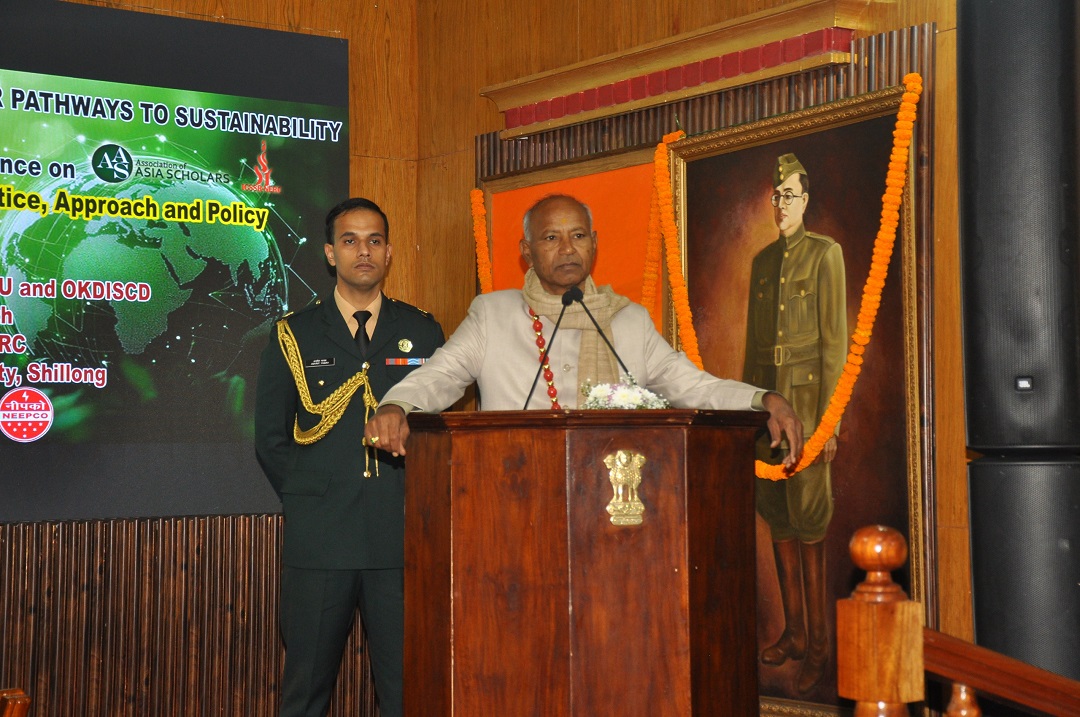
SHILLONG, Nov 10: Meghalaya Governor CH Vijayashankar has praised the state’s deep-rooted cultural traditions and its longstanding commitment to environmental stewardship, saying the people of Meghalaya have lived in harmony with nature for generations.
Speaking at the inauguration of the 4th Annual International Conference of the Society for Pathways to Sustainability (PathS) at Raj Bhavan, the Governor said Meghalaya is both a natural and cultural repository of sustainable practices. He highlighted that traditional communities in the state continue to follow organic and low-impact farming methods and uphold a cultural ethos that respects nature.
He noted that these values are aligned with India’s ancient civilisational wisdom, which emphasised a balance between material progress and ecological responsibility.
However, Governor Vijayashankar expressed concern that modern industrial development patterns across the world have become highly extractive, leading to environmental degradation, depletion of natural resources and increasing socio-economic inequalities.
Referring to the current ecological crisis, he warned that widespread monoculture plantations create long-term ecological imbalances by disrupting natural nutrient cycles and weakening biodiversity linkages, especially in fragile ecosystems. He stressed the need to prioritise native species, protect endangered flora, and focus on medicinal plants, which play a vital role in preserving genetic diversity and strengthening natural resilience.
The Governor urged researchers, academicians, students and stakeholders attending the conference to adopt pragmatic, evidence-based and practical approaches in their work so that sustainable solutions can be tailored to real local conditions and contribute to India’s long-term development pathway.
Highlighting the North East’s vulnerability to climate disruptions, he cited the visible impacts of climate change in Mawsynram, the world’s wettest place, where rainfall patterns, seasonal distribution and climatic rhythms are already shifting. Increasing instances of abnormal rainfall, monsoon variability, soil erosion and habitat loss are clear indicators that climate change is affecting the region, he said.
He called on scholars to scientifically document these changes and develop research-backed frameworks to guide policymakers in protecting the region’s ecological future.
The Governor congratulated NEHU and partner institutions for hosting the global academic dialogue in Meghalaya, expressing confidence that the conference would generate valuable recommendations to support India’s sustainable development goals, as envisioned by Prime Minister Narendra Modi.
The two-day conference, themed “Sustainable Development: Theory, Practice, Approach and Policy,” is jointly organised by the Department of Economics, North Eastern Hill University (NEHU), Society for Pathways to Sustainability (PathS), OKDISCD Guwahati, AAS and ICSSR-NERC.
More than 100 research papers will be presented in online and offline modes, alongside multiple thematic panel discussions, including a special session on “Sustainable Development in the North East: Challenges and Opportunities.”