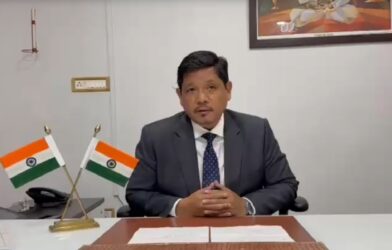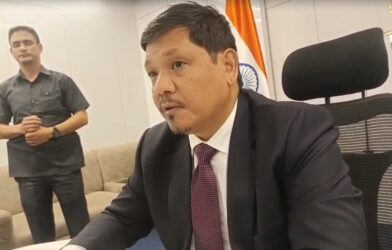


SHILLONG, APR 2: Education Minister Lahkmen Rymbui said the state government is weighing a fee revision in government colleges to reduce their dependence on official grants and allow them to fund routine activities from their own revenues.
Speaking after a review meeting on Thursday, Rymbui noted that government college fees remain far lower than those in deficit or private institutions, limiting principles’ flexibility.
“We cannot deny the fact that the fees in government colleges are very less compared to people’s colleges or deficit colleges,” he said.
Under the proposed model, colleges would raise fees modestly—by 10–15 percent—with the additional portion payable once students receive post-matric scholarships.
“Suppose a college collects Rs 11,000 or Rs 12,000 now; let us make it Rs18,000– Rs19,000. The student pays what they can now, and the rest after the scholarship comes,” Rymbui explained.
He cited Kiang Nangbah Government College as an illustration: an Rs 8,000 increase per student across 3,000 enrolments would generate about Rs 2.4 crore annually.
“With this fund, the college will not come to us to sanction money for college week, excursions, or appointment of new teachers,” he said.
The minister stressed that the change would not burden students because the post-matric scholarship reimburses tuition directly to colleges—not to students’ pockets.
“This will not put a burden onto the student because the government will reimburse,” he said.
He contrasted government colleges with institutions such as St Edmund’s and St Anthony’s, where higher fees are offset by larger scholarship flows.
To ensure transparency, Rymbui said each college must form a committee with faculty and student representatives to oversee the use of collected fees.
“Whatever they use, they should use it for the betterment of education,” he said.
He also urged colleges to secure UGC 12B and 2F recognition and pursue accreditation, saying self-assessment helps government target support.
“Before it was NAAC, now the new body will come, but they have to do it because this self-assessment is very important,” he said.
Turning to schools, Rymbui directed officials to mandate two parent-teacher meetings a year in government schools—at mid-year results and ahead of final exams—to build community oversight.
“Government schools are like nobody’s taken care of. We want at least during result day there should be a parent-teachers meeting… so there will be a sense of belonging and ownership,” he said.
Rymbui cautioned that some proposals could be implemented immediately while others require consultation. “
We are here to serve the people of the state, and anything we do, we do for betterment,” he said.