
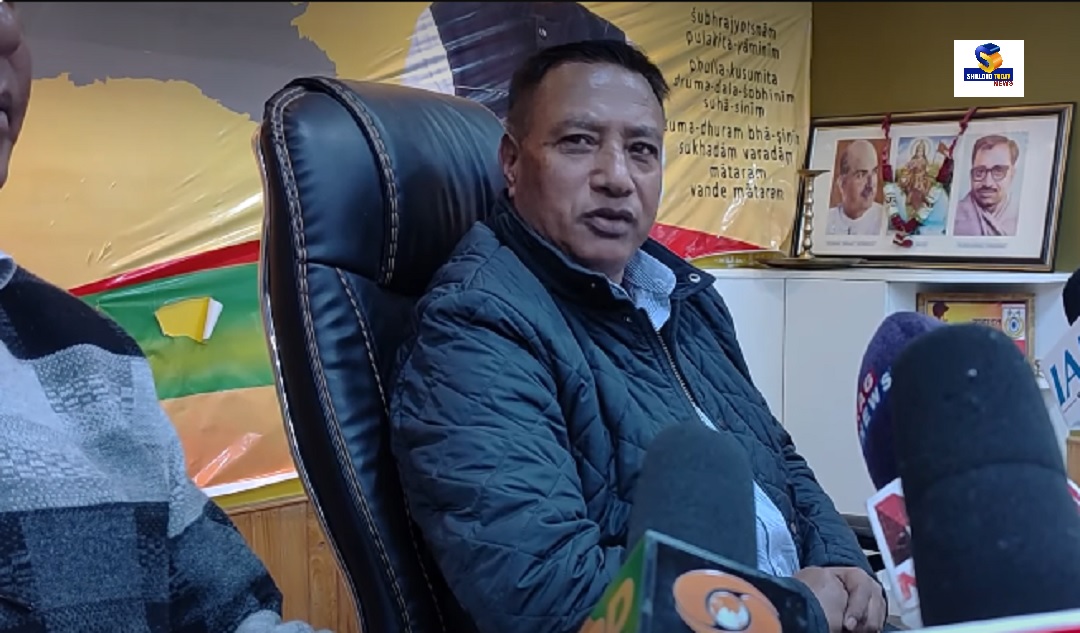
SHILLONG, MAY 18: Assam and Meghalaya are working to resolve their long-pending interstate border dispute “amicably” without pressure from either side, BJP leader and Pynthorumkhrah legislator AL Hek said on Monday.
“So the government of Meghalaya and Assam are negotiating to ensure that one day they will come to a conclusion that they can solve this problem,” Hek told reporters.
“We want to solve this issue amicably.”
He acknowledged political pressure on both states but stressed that the approach remains non-confrontational.
“Now, there is political pressure from Assam, there is political pressure from Meghalaya,” he said. “That is why we also, from the BJP, from NPP or the government, we don’t want to put pressure on anyone. We are working amicably.”
Hek noted that border fencing, while “required and mandatory” for Meghalaya as it is for West Bengal, is linked to the dispute. “Of course, in Meghalaya also, it is required. I am not saying it is not required,” he said. “But here in Meghalaya there are lots of land disputes between Assam and Meghalaya and many other states.”
He said the MDA government has been actively reviewing the issue through institutional mechanisms.
“From time to time, we in the MDA government discuss this border issue,” Hek said.
“We have seen even border committees of all districts. If you talk about Block I and II, and in Ri Bhoi, they have got their own committees, which are headed by MLAs from different political parties to resolve this issue.”
Hek cautioned that the dispute cannot be settled quickly and requires extensive field verification. “It is not only in one sitting you can solve the problem,” he said. “You have lots of survey teams from the Government of India, from the state government. So there are so many things to discuss. It is not that sitting across the table we can solve that issue. We have to go to the ground and study the ground reality. Once you understand the ground reality then they can know how to solve the problem.”
He added that engagement with the Centre on border infrastructure is ongoing and must be led by the state government. “This has to be from government to government and not a single party can approach the Centre. This is the responsibility of the state government. It is a continuous process,” Hek said.