
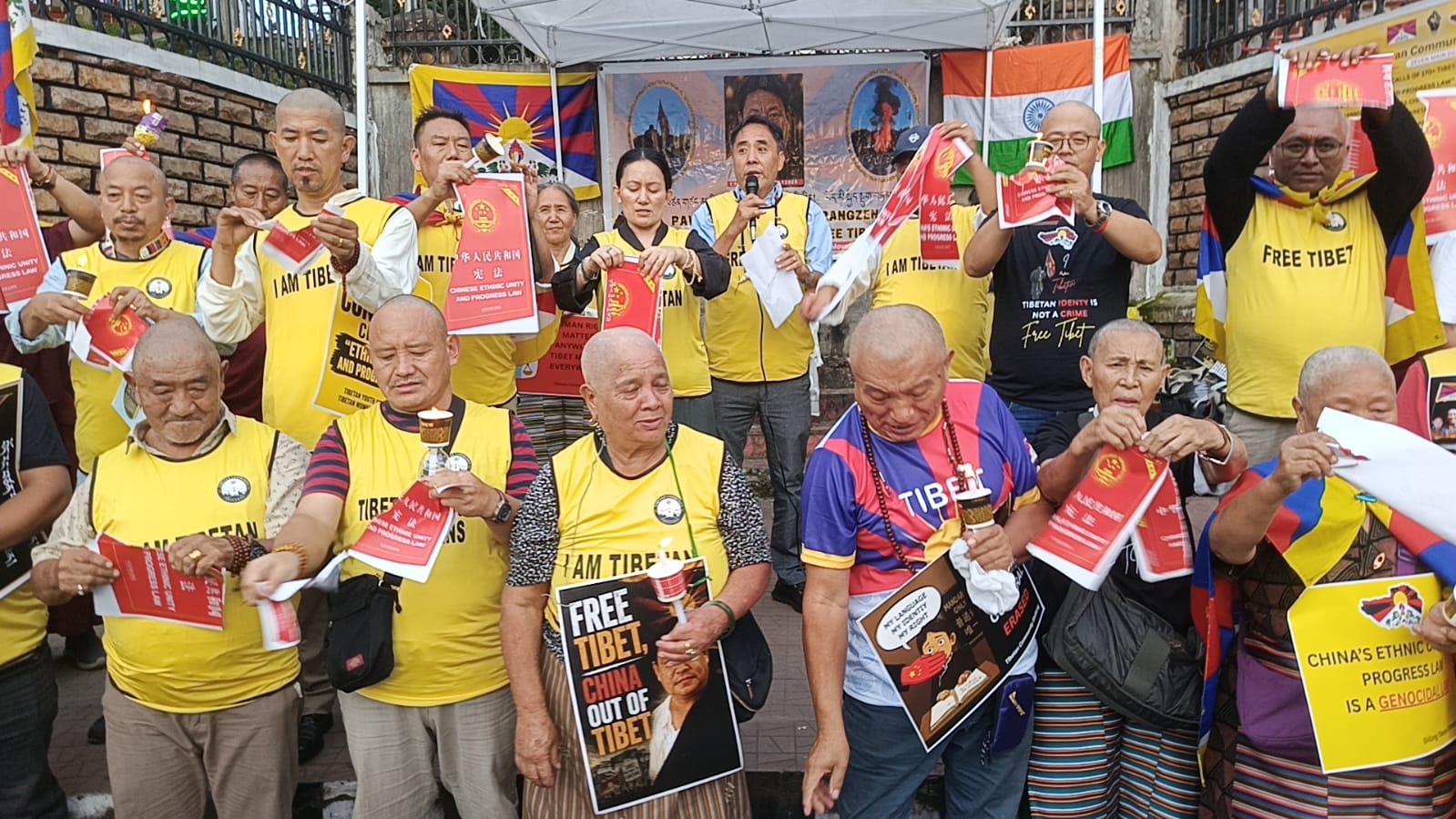
Shillong, August 12: The Tibetan community in Shillong on Wednesday held a peaceful candlelight vigil at the Old Assembly Gate to mourn the death of Tibetan activist Lobsang Palsang, also known as Lobga Rangzen, who reportedly died after self-immolating outside the United Nations Headquarters in New York on July 2, 2026.
The gathering brought together members of the Tibetan community to express grief and solidarity, while drawing international attention to what participants described as continuing restrictions on Tibetans’ language, culture, religion and identity under Chinese rule.
Participants carried placards with messages including “Tibetan Identity Is Not a Crime” and “No Laws Can Erase Us.” Several men and women also shaved their heads as a mark of mourning and as a symbolic expression of resistance to what they described as attempts to suppress Tibetan identity.
Speaking to the media, Tibetan media coordinator and research activist Tenzin Sangmo said the incident in New York should not be viewed merely as the death of an individual, but as a call for the international community to listen to the grievances of the Tibetan people.
She said Wednesday’s vigil was also held in opposition to China’s Law on Promoting Ethnic Unity and Progress, which came into effect on July 1, 2026.
According to Sangmo, Tibetans fear that the legislation could accelerate the assimilation of ethnic minorities by weakening their distinct languages, cultures, religions and historical identities.
“Tibetan identity is not a crime. No law can erase our identity, history and spirit,” Sangmo said.Sangmo also raised concerns over what she described as increased surveillance of monasteries, restrictions on the movement of monks and nuns, and efforts to influence religious teachings in line with the ideology of the Chinese Communist Party.
She said Tibetans, under the leadership of the Dalai Lama, had pursued dialogue and a peaceful settlement through the Middle Way Approach for nearly four decades.
However, she said the lack of a clear response from Beijing had led sections of the Tibetan community to renew calls for complete independence.
The Shillong Tibetan community appealed to the Government of India, the United Nations and the international community to speak up for the protection of Tibetan human rights, religious freedom, language and cultural identity.
China maintains that its new legislation is aimed at strengthening national unity and promoting ethnic harmony.
Tibetan groups and human rights organisations, however, have expressed concern that the law could further undermine the distinct identities and cultural rights of ethnic minorities.