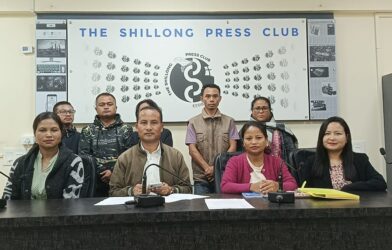

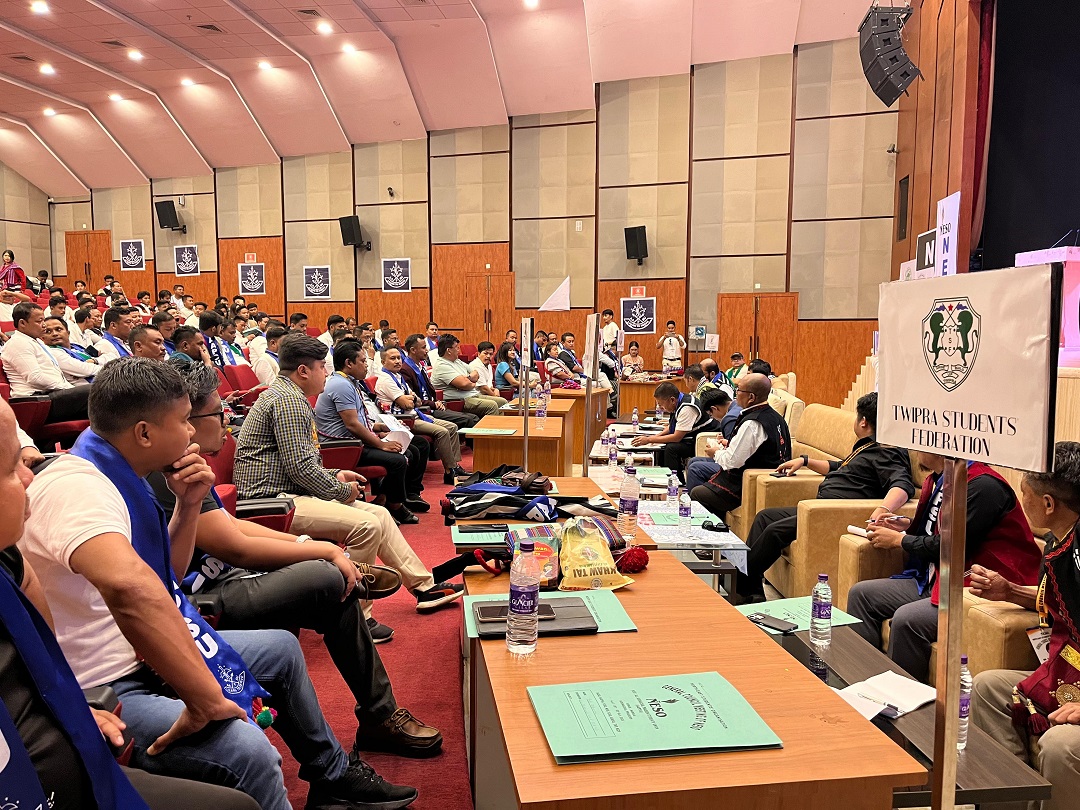
SHILLONG, Nov 19: The North East Students’ Organisation (NESO) has submitted an eleven-point charter of demands to Meghalaya Governor C.H. Vijayashankar, urging the Centre to take urgent and comprehensive measures to address what it describes as the escalating threat posed by illegal migration in the region.
At the top of NESO’s demands are the immediate detection and deportation of all illegal migrants, complete sealing of the Indo-Bangladesh border, and the implementation of the Inner Line Permit (ILP) system across the entire North East.
In the memorandum, NESO Chairman Samuel B. Jyrwa stressed the need for strong and sustained action to protect the region’s indigenous populations. “We urge the Government of India to treat this issue with the seriousness and urgency it demands. The demographic and cultural changes already visible in parts of our region are warnings of an existential crisis,” he wrote. “If strong and sustained measures are not taken now, the very identity of the North East’s indigenous peoples could be irreversibly altered.”
NESO also called on the Centre to strengthen border controls in vulnerable areas by deploying adequate security personnel and modern surveillance systems. The organisation further demanded the total exemption of the Citizenship (Amendment) Act, 2019, and the Immigration and Foreigners (Exemption) Order, 2025, from the entire region.
Among the key demands are:
Implementation of the Assam Accord (1985) in letter and spirit.
Constitutional safeguards for the indigenous people of Assam as recommended by the Justice Biplab Kumar Sarma Committee, and similar safeguards for the indigenous communities of Tripura.
Preparation of a National Register of Citizens (NRC) for the whole North East with specific base years for each state, and re-examination of the NRC in Assam.
Measures to ensure migrants are not relocated within the region.
Legal and policy protections for indigenous rights, culture, language, political autonomy, and land ownership.
Establishment of a Special Review Committee to examine population explosions in select areas.
NESO warned that unchecked illegal influx since 1947 has deeply impacted the socio-cultural fabric, demographic profile, and political stability of the region. The memorandum cites the case of Tripura, where indigenous communities have been reduced to a minority, as well as the prolonged anti-foreigner movements in Assam, culminating in the 1985 Assam Accord, whose promises remain largely unfulfilled.
It also recalls past agitations in Meghalaya—particularly in 1979, 1987 and the early 1990s—and highlights the changing demographic patterns in Assam, which the organisation claims are now spilling over into neighbouring states, including the plains of Garo Hills.
NESO further criticised recent central policies such as the CAA 2019 (partially exempted in the North East) and the Immigration and Foreigners (Exemption) Order 2025, arguing that these measures worsen the issue by allowing certain categories of migrants from Afghanistan, Bangladesh, and Pakistan to remain in India.
The organisation reiterated that the problem is not merely administrative but existential, threatening the languages, traditions, and cultural identities of indigenous communities across the North East.