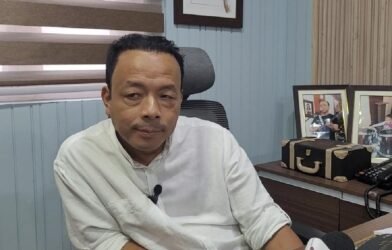


SHILLONG, Apr 22: Concerns are mounting in Meghalaya over the upcoming three-language mandate by the Central Board of Secondary Education (CBSE), with Education Minister Lahkmen Rymbui warning that students may be forced to study unfamiliar languages due to the exclusion of Khasi and Garo from the board’s approved list.
The CBSE is set to implement a compulsory three-language structure—R1, R2 and R3—from the 2026–27 academic session. However, Khasi and Garo are not among the 44 languages currently recognised under its scheme, raising concerns for students in the state.
Rymbui said he has formally written to the Union Education Minister and also met the CBSE chairman, urging inclusion of the two indigenous languages.
“Recently, the CBSE has mandated that the three languages – R1, R2 and R3 – and in the scheme of language of CBSE, Khasi and Garo are not there,” he said. “So, it would be very difficult for the students of Meghalaya.”
At present, Khasi and Garo are taught in CBSE-affiliated schools only up to Class VIII, in line with provisions of the Right to Education Act and the National Education Policy 2020, which emphasise mother tongue instruction at the elementary level. Under the new rule, students will need to study and appear for all three languages in their Class X board exams by 2031.
Highlighting the implications, the minister noted that students in CBSE schools—including Jawahar Navodaya Vidyalaya (JNVs), Kendriya Vidyalaya (KVs), and private institutions—will face difficulty choosing languages not native to them.
Meghalaya currently has nine private CBSE schools, along with several JNVs, KVs, and two operational Eklavya Model Residential Schools (EMRS) at Pahamsyiem and Samanda. With 36 more EMRS planned, over 2,000 students are expected to sit for CBSE exams annually.
Rymbui also pointed out that the state Cabinet had recently accorded official language status to Khasi and Garo, strengthening the case for their inclusion in the CBSE framework. As an interim solution, he suggested that the Meghalaya Board of School Education could provide academic support and resources until national-level bodies like National Council of Educational Research and Training develop standard textbooks.
Beyond academics, he stressed that recognising Khasi and Garo in CBSE schools would generate employment opportunities for language teachers and support the long-standing demand to include these languages in the Eighth Schedule of the Constitution of India.
“I am very positive… in due course of time, Khasi and Garo will be taught in CBSE affiliated schools,” Rymbui added.