
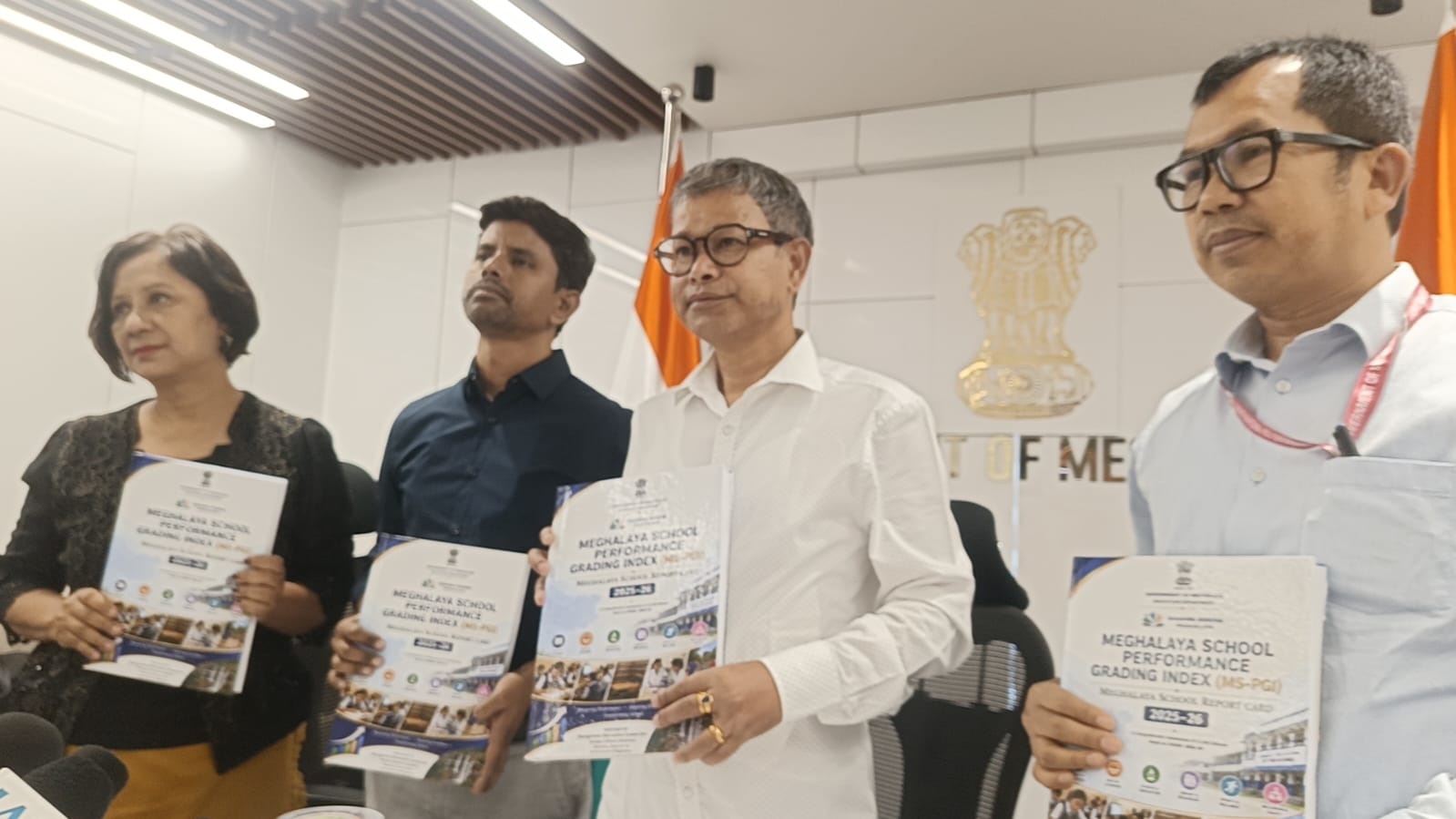
Shillong, July 24: Meghalaya on Friday launched its first-ever Meghalaya School Performance Grading Index (MSPGI) 2025-26, a comprehensive assessment covering 11,453 schools across the state, with Education Minister Ma Lahkmen Rymbui asserting that the initiative is designed to improve educational standards rather than shame underperforming institutions.
Launching the report, Rymbui said the grading exercise marks the beginning of a transparent, data-driven approach to strengthening school education by enabling every institution to identify its strengths, weaknesses and areas requiring improvement.
“This is the first report of its kind. We should not jump to conclusions. It is the beginning of a process. Every school now knows where it stands and what it needs to improve,” the minister said.
He stressed that schools across Meghalaya operate under different circumstances and face varying challenges, making it essential to evaluate each institution on its own merits instead of adopting a one-size-fits-all approach.
The minister clarified that the rankings are intended to encourage improvement and healthy competition, not to embarrass schools with poor performance.
“The purpose is for every school to know where it stands, understand its strengths and weaknesses, and work towards improving its performance,” he said.
The MSPGI covers schools from pre-primary to higher secondary level, including government, government-aided, private, mission and CBSE institutions. The rankings were compiled using data from UDISE+ along with other verified educational indicators, making it one of the state’s largest education data exercises.
The assessment evaluates schools on a broad range of parameters, including infrastructure such as school buildings, boundary walls, drinking water, electricity, separate toilets for boys and girls, playgrounds, libraries, laboratories, internet connectivity, smart classrooms, desktop and laptop facilities, approach roads, science laboratories and safety measures.
In addition, the index measures teaching-learning processes, student enrolment and attendance, learning outcomes, teacher and headmaster availability, implementation of government schemes, school management and several academic and administrative indicators.
Rymbui said the government had deliberately placed the findings in the public domain to ensure transparency and enable parents, teachers, school authorities and communities to understand the status of every school.
“We are not hiding our shortcomings. Transparency will help everyone identify the gaps and work together to improve the education system,” he said.
While acknowledging that some schools performed exceptionally well and others scored poorly, the minister said no immediate punitive action was being considered against low-performing institutions.
He, however, noted that schools exist to provide quality education and not merely to continue functioning. Schools that consistently fail to improve despite adequate support may eventually face a review of their recognition, although no specific timeline has been fixed.
Rymbui also pointed out that schools with extremely low enrolment naturally raise questions about their continued viability, observing that a school without students defeats its very purpose.
Highlighting the broader education reforms undertaken by the government, the minister said Meghalaya has made steady progress over the past eight years, although significant challenges remain.
“We are doing everything possible and the Education Department has tried its best, but challenges remain. Providing quality education is a shared responsibility involving the government, schools, teachers, parents and communities,” he said.
He said the state introduced the MSPGI after the Government of India released its national school performance assessment, enabling Meghalaya to develop a more detailed state-level evaluation framework.
The minister added that the Education Department has already initiated measures to fill teacher vacancies, rationalise staff deployment and strengthen schools through various interventions. The grading exercise will be conducted regularly—either annually or every two years—to monitor progress and encourage continuous improvement.
Describing the initiative as a landmark achievement, Rymbui commended officials and the technical team for compiling and analysing data from more than 11,000 schools.
He expressed confidence that the School Performance Grading Index would become an important benchmark for policymakers, district administrations and school authorities, helping improve learning outcomes and raise educational standards across Meghalaya.