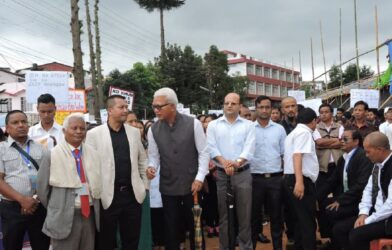

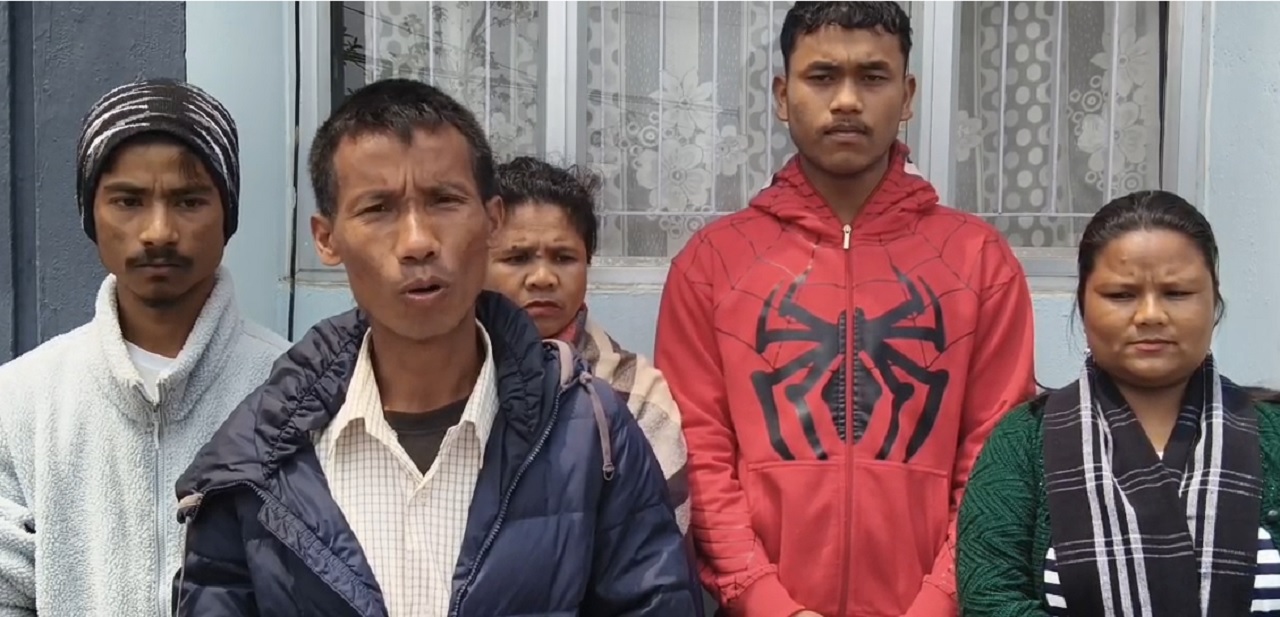
Jowai, April 13: The Hynniewtrep Border Dispute Redressal Forum (HBDRF) on Tuesday observed April 13 as a “Black Day” to mark what it termed a historic injustice linked to the Assam-Meghalaya boundary issue.
During a brief meeting held in Jowai, the Forum expressed deep resentment and grief over the alleged forcible transfer of certain areas to Assam in 1951. According to the HBDRF, April 13 marks the controversial decision when regions such as Labang-Nangphyllut (Block-1) and Raij Nongtung Khyrwang (Block-2) were transferred to the then United Cachar & Mikir Hills—now under the Karbi Anglong Autonomous Council—through an official notification.
The Forum alleged that the transfer was carried out without the knowledge or consent of the indigenous Khasi and Pnar inhabitants, who it maintains are the rightful settlers of the land. It further claimed that the Boundary Commission at the time relied solely on “table work” without conducting proper ground-level surveys of the affected villages and communities.
HBDRF members noted that the 1951 notification triggered unrest in the region, as it led to the separation of areas from traditional Khasi-Jaintia administrative units, including Elaka Raliang, Elaka Chilliangmyntang, Elaka Nongjngi, and Elaka Nartiang, and their subsequent inclusion under a different jurisdiction.
The Forum also highlighted that following protests, the Assam government issued another notification on March 13, 1957, temporarily suspending the earlier order. A joint survey conducted on February 17, 1958, by the United Cachar & Mikir Hills and the United Khasi & Jaintia Hills District Councils had reportedly recommended the re-transfer of the disputed areas back to the Khasi-Jaintia Hills.
However, the HBDRF lamented that despite these developments, the issue remains unresolved, with no final implementation of the recommended re-transfer.
Speaking on the occasion, HBDRF Chairman Bah Chandame Sungoh asserted that the Forum will continue to observe April 13 as a Black Day every year until Block-1 and Block-2 are restored to the Khasi-Jaintia region, maintaining that these areas historically belong to its people.