
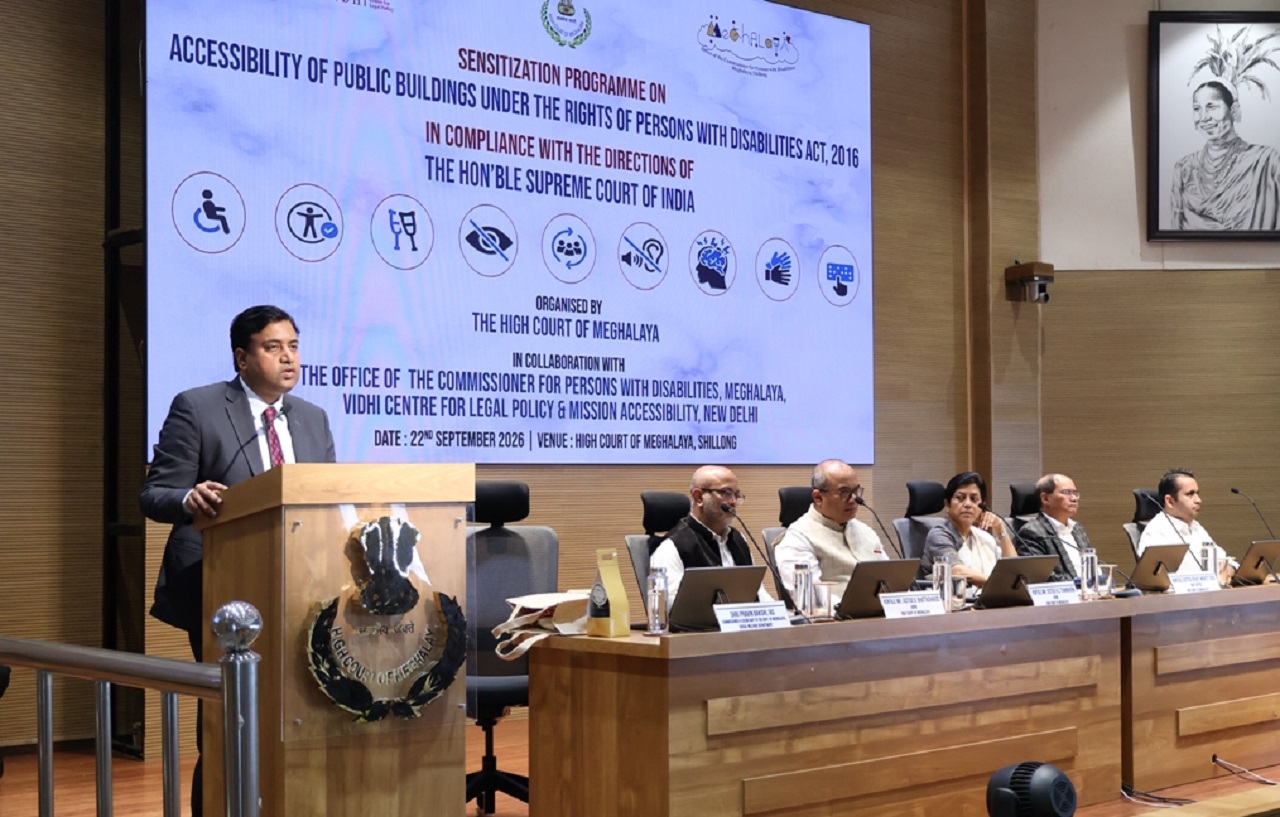
Shillong, Sept 22: The High Court of Meghalaya, in collaboration with the Office of the Commissioner for Persons with Disabilities, Meghalaya, Vidhi Centre for Legal Policy and Mission Accessibility, New Delhi, organised a sensitisation programme on accessibility of public buildings under the Rights of Persons with Disabilities (RPwD) Act, 2016, in compliance with the directions of the Supreme Court of India, at the High Court Auditorium here on Tuesday.
Addressing the gathering, Chief Justice of the High Court of Meghalaya, Justice Revati Mohite Dere, said the RPwD Act was enacted to protect the rights and dignity of persons with disabilities, prevent discrimination, ensure equality and equal opportunities, and establish mechanisms for the effective implementation and enforcement of their rights.
Justice Dere observed that despite several Supreme Court judgments, persons with disabilities continue to face hardships, with gaps in the implementation of the Act and judicial directions remaining a major concern. She attributed the situation, among other factors, to a lack of awareness and sensitivity towards the challenges faced by persons with disabilities.
She emphasised that persons with disabilities seek independence, dignity and self-respect rather than sympathy. “Instead of encouraging them to be independent and self-reliant, we tend to create barriers and obstacles by ignoring their rights and needs,” she said.
Justice Dere stressed the need to train technical personnel, including engineers and architects, as well as officials involved in the planning, design and construction of public buildings, so that accessibility and universal design principles are incorporated from the initial stage of planning.
She urged officials to view accessibility not merely as a legal obligation but as an opportunity to create inclusive infrastructure. Schools, colleges, offices and other public institutions, she said, must be designed to enable persons with disabilities, including children, to move freely and independently.
“People with disabilities succeed when all institutions, public or private, choose to be inclusive,” she said, calling for concerted efforts to enable persons with disabilities to move from dependency to independence, confidence and greater participation in society.
She also underlined that accessibility must extend to roads, public buildings, workplaces, restrooms and other facilities used in everyday life. “A door is not accessible if it needs another person to open it,” she said, stressing that human dignity must remain central while constructing buildings, approving projects and developing public infrastructure.
Justice Dere further said dignity and accessibility were not matters of charity but rights guaranteed under the Constitution and the RPwD Act. She said accessibility was a precondition for the exercise of fundamental rights, including the rights to life, education and access to justice.
Commissioner and Secretary of the Social Welfare Department, Pravin Bakshi, IAS, said accessibility was a legal mandate and called for its integration into building regulations, planning permissions, construction and maintenance.
He informed that access audits had been conducted in 15 district courts and six district prisons and correctional homes to identify barriers and improve accessibility.
The one-day programme was attended by Justice H.S. Thangkhiew, Justice B. Bhattacharjee and Justice W. Diengdoh, Judges of the High Court of Meghalaya, along with officials from the Social Welfare Department, Police Department and other government departments, besides invited participants and stakeholders.
The programme also featured expert sessions aimed at enhancing officials’ understanding of accessibility requirements and supporting the effective implementation of the RPwD Act and constitutional provisions relating to equality, dignity and accessibility.