
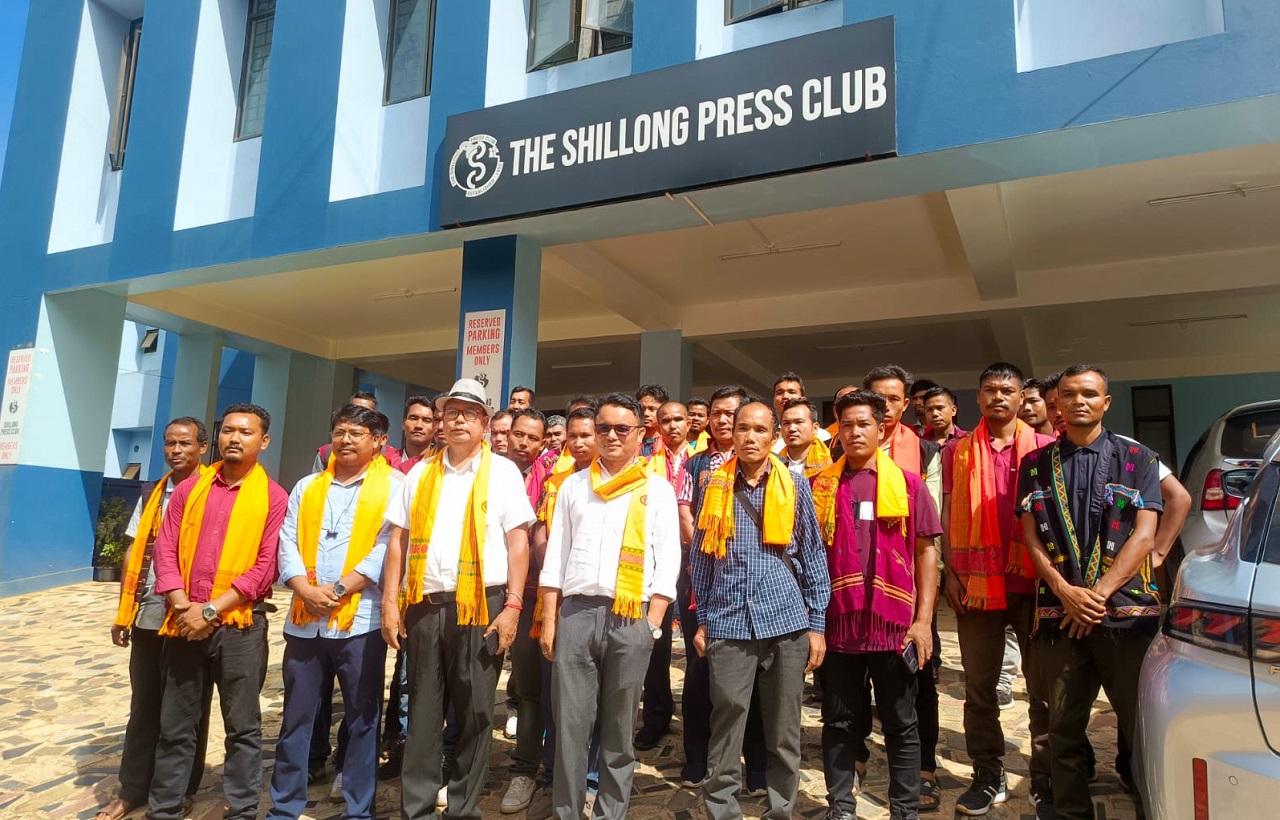
Shillong, July 6: The All Tiwa Students’ Union (ATSU), Meghalaya State Committee, has renewed its long-standing demand for the inclusion of the Tiwa (Lalung) community in the Scheduled Tribe (ST) list of Meghalaya, stating that the issue has become increasingly urgent ahead of the 2027 Census.
Addressing a press conference at the Shillong Press Club on Sunday, ATSU General Secretary Albert Dilar said the community fears it may once again be left out of official records if the name “Tiwa (Lalung)” is not included in the state’s Scheduled Tribe list before the Census process begins. He noted that the house-listing and house-numbering phase of the 2027 Census is expected to commence in August 2026.
Dilar said the union is unable to understand why the Tiwa community continues to remain excluded from Meghalaya’s Scheduled Tribe list despite considering itself one of the indigenous communities of the state. He argued that the exclusion does not reflect the community’s historical presence, cultural identity and traditional geographical roots in Meghalaya.
According to ATSU, the union, along with other Tiwa organisations, has been submitting memoranda and representations to both the Meghalaya Government and the Government of India for more than three decades through peaceful and constitutional means. However, it claimed that no final decision or satisfactory response has been received.
While the union did not provide an official estimate of the Tiwa population in Meghalaya, it stressed that proper enumeration of the community during the 2027 Census is crucial to ensure accurate demographic records.
To support its demand, ATSU cited historical references, including records of the ancient Gobha Kingdom, writings of noted Khasi scholar Bah B. Pakem documenting the presence of the Tiwa people, historical administrative records indicating Tiwa settlements in present-day Ri-Bhoi and adjoining areas, and letters and certificates issued by the Syiem of Hima Khyrim, Dr. Balajied Sing Syiem, recognising the Tiwa community as indigenous to Meghalaya. The union also maintained that Tiwa ancestral lands became part of Meghalaya following the state’s creation in 1972.
ATSU alleged that neither the State Government nor the Central Government has provided any concrete assurance regarding the community’s demand for Scheduled Tribe recognition.
The organisation emphasised that its demand is not intended to affect the rights or status of existing Scheduled Tribes in Meghalaya. Instead, it said the objective is to secure constitutional recognition of the Tiwa community’s historical identity and indigenous status.
According to the union, granting Scheduled Tribe status would facilitate official recognition of the Tiwa community in Meghalaya, ensure proper inclusion in Census and government records, safeguard constitutional and legal rights, improve access to welfare schemes meant for Scheduled Tribes, and help preserve the community’s identity, culture and traditional rights.
ATSU further warned that if the issue remains unresolved, it will explore all available legal, democratic and constitutional avenues, including approaching the courts if necessary. However, the union reiterated that it remains committed to pursuing the matter through dialogue and peaceful constitutional means.