
Guwahati, September 26, 2026: A week-long residential training programme aimed at strengthening the capacity of frontline forest staff for Western Hoolock Gibbon conservation concluded at the Gibbon Conservation Centre of Aaranyak in Hollongapar Gibbon Sanctuary, Mariani, Assam.
The first batch, held from September 19 to 25, brought together 15 Forest Guards from the Forest Departments of Assam, Meghalaya and Nagaland. It marked the first time frontline forest personnel from the three states participated in a dedicated training programme focused on Hoolock Gibbon conservation.
The programme sought to strengthen field-level knowledge and practical skills among forest personnel to support the long-term conservation of the Western Hoolock Gibbon and its increasingly fragmented habitat.
It was organised by biodiversity conservation organisation Aaranyak in collaboration with the Jorhat Forest Division of the Assam Forest Department, with support from The Habitats Trust and the IUCN Primate Specialists Group.
The Western Hoolock Gibbon, described as India’s only ape, is found across the northeastern states south of the Brahmaputra and east of the Dibang River. Poaching, encroachment and habitat fragmentation remain major threats to the species, while limited awareness and field-level knowledge pose additional conservation challenges.
The training combined classroom sessions with hands-on field exercises covering biodiversity conservation in Northeast India, primate conservation, Hoolock Gibbon census and population estimation, field data collection and reporting, floristic studies, habitat characteristics and restoration, population and habitat monitoring, rescue and rehabilitation, GPS use and wildlife laws.
The trainees also undertook field observations across five tracks over five days, gaining practical experience in field research and conservation techniques.
The programme was inaugurated on September 19 by Dr. Dilip Chetry, Director and Head of the Primate Research and Conservation Division at Aaranyak and Vice Chair of the IUCN Primate Specialist Group South Asia.
Welcoming the participants, Dr. Chetry encouraged them to actively engage in the training and apply the knowledge gained towards biodiversity conservation, particularly the protection of Hoolock Gibbons. He also acknowledged the cooperation and logistical support provided by the Jorhat Forest Division.
Training sessions and field exercises were conducted by experts from Assam Agricultural University, the Assam Forest Department, USTM and Aaranyak, including Dr. I.C. Baruah, Gunin Saikia, Dr. Prabal Sakar, Avisekh Sarkar, Simanta Medhi, Nandita Medhi, Dr. Khanin Changmai and Dr. Dilip Chetry.
At the concluding session on September 25, the significance of bringing frontline personnel from three states together for Hoolock Gibbon conservation was highlighted.
Dr. Chetry thanked the Assam, Meghalaya and Nagaland Forest Departments for deputing their frontline staff and acknowledged the support of the Assam Forest Department, particularly the Jorhat Forest Division, as well as the local community.
He urged the trainees to translate their learning into field action and use the skills gained during the programme to strengthen the conservation of Hoolock Gibbon habitats and the species.
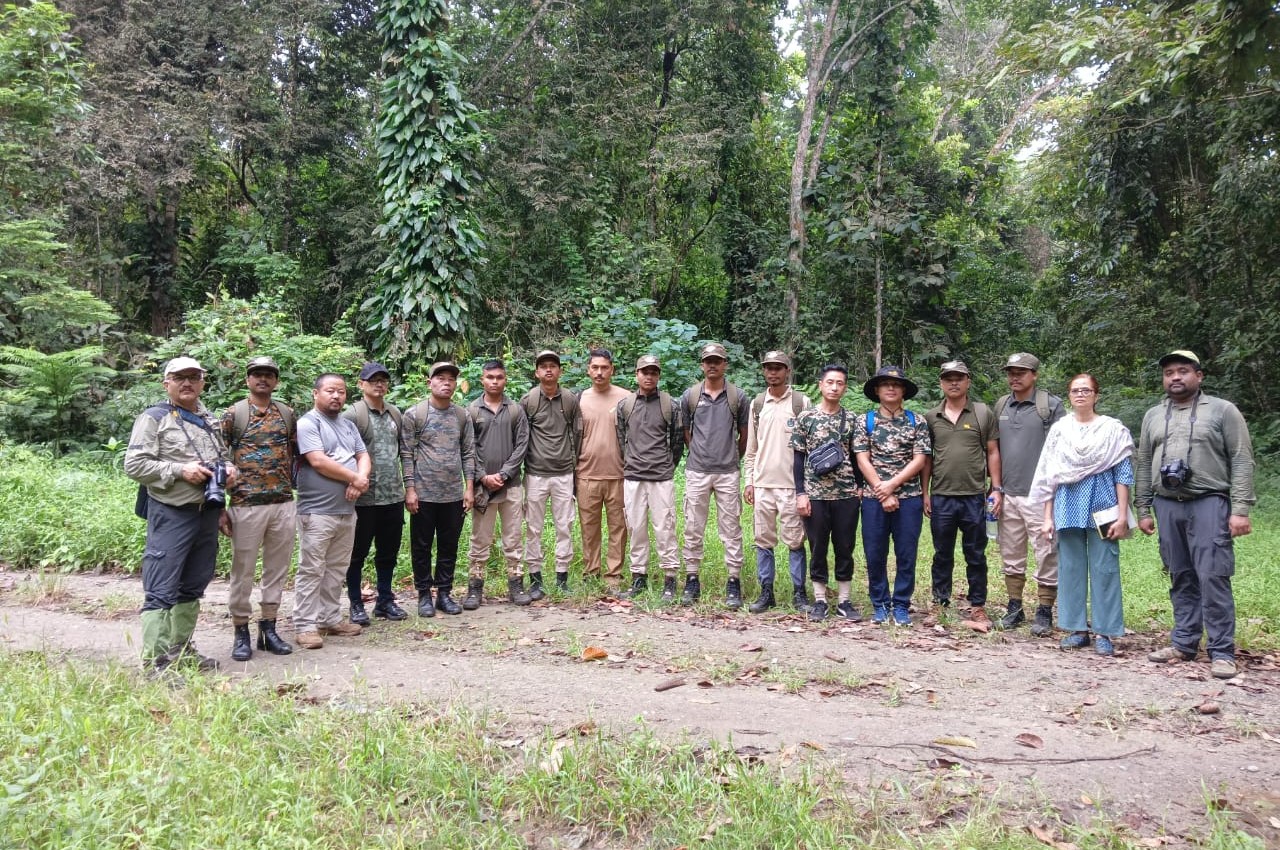
The programme concluded with the distribution of training manuals, books on Hoolock Gibbons, conservation posters, certificates of participation and group photographs to the trainees.