
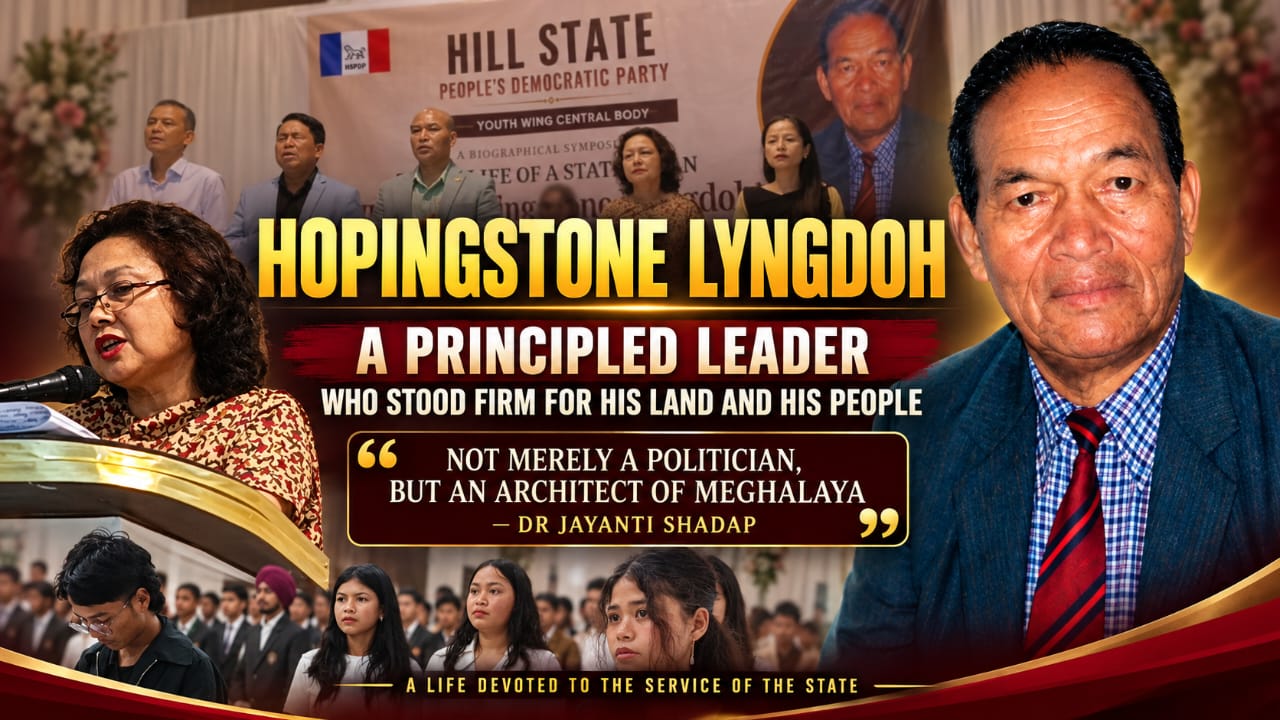
Shillong, September 26, 2026: Research scholar and St Edmund’s College faculty member Dr Jayanti Shadap has highlighted the political journey, principles and lasting legacy of late Hopingstone Lyngdoh Nonglait, describing him as a self-made and principled leader whose political life was closely linked with Meghalaya’s struggle for statehood.
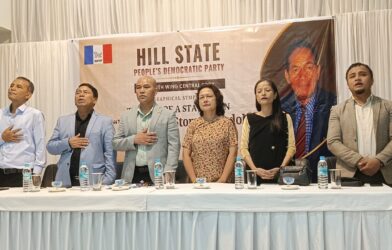
Dr Shadap was speaking at a symposium held at Shillong Club on Saturday to commemorate Lyngdoh’s 11th death anniversary.
Addressing students and participants, she said Lyngdoh’s political career reflected wisdom, courage, integrity and a strong commitment to the interests of the people. She emphasised that his life should be studied not only as the story of an individual politician, but also as an important chapter in Meghalaya’s political history.
Born on March 15, 1929, Lyngdoh faced several difficulties during his early years but continued his education despite limited opportunities. Dr Shadap said these experiences shaped his lifelong concern for education and the development of disadvantaged communities.
Lyngdoh entered electoral politics in the 1950s and was first elected to the United Khasi-Jaintia Hills District Council in 1957. He later entered the Assam Legislative Assembly and remained connected with electoral politics for several decades.
A major focus of Dr Shadap’s presentation was Lyngdoh’s role in the Hill State Movement, particularly the opposition to the Assam Official Language Bill of 1960.
She explained that the proposal to make Assamese the official language of Assam created concern among the Khasi, Jaintia and Garo communities over language, education, employment and cultural identity. The opposition to the language policy helped strengthen the demand for a separate Hill State.
Dr Shadap noted that the movement was pursued through democratic and constitutional means, including negotiations, public meetings, demonstrations and peaceful protests.
She also discussed various political proposals put forward during the movement, including the Scottish Plan, Nehru Plan, Pataskar Commission and Federal Plan. According to her, hill leaders rejected or raised concerns over these arrangements because they felt the proposals did not adequately protect the political, linguistic and constitutional interests of the tribal communities.
The creation of an autonomous state within Assam in 1968 marked another significant stage. However, Lyngdoh opposed the arrangement, believing that the movement had promised the people a full-fledged state.
His position eventually led to his expulsion from the All Party Hill Leaders’ Conference.
Dr Shadap described the episode as an example of Lyngdoh’s political principles, saying he remained committed to full statehood despite facing political isolation.
After initially withdrawing from active politics, Lyngdoh was persuaded by supporters of the Hill State Movement to return to the struggle. He subsequently continued to participate in peaceful protests, public mobilisation and demonstrations, while taking the demand for statehood to New Delhi.
Meghalaya ultimately attained full statehood on January 21, 1972.
Beyond the statehood movement, Dr Shadap highlighted Lyngdoh’s close relationship with the people of his constituency. She said his political influence was built largely on accessibility, personal contact and the trust he earned among ordinary people.
Education was another major area of his work. Dr Shadap said Lyngdoh believed political freedom needed to be accompanied by educational and economic empowerment and supported efforts to expand schooling in rural and remote areas.
She also highlighted his early opposition to uranium mining in Meghalaya. According to Dr Shadap, Lyngdoh raised concerns about the potential impact of uranium extraction on land, water, health, the environment and indigenous communities at a time when environmental issues had received comparatively less public attention.
His international engagements, including participation in conferences in Europe during the early 1990s, also exposed him to wider discussions on environmental protection and indigenous rights.
Dr Shadap further spoke about Lyngdoh’s concern for the Khasi language and indigenous identity, as well as his efforts to promote understanding between the Khasi-Jaintia and Garo communities.
She said Lyngdoh believed that Meghalaya’s major indigenous communities needed to work together through equality, mutual respect and practical political understanding.
Concluding her presentation, Dr Shadap urged younger generations to study Lyngdoh’s political journey beyond his positions as an MLA, MDC, MP or founder of the HSPDP.
She said his legacy included moral courage, consistency, commitment to democratic methods and his willingness to stand by issues he considered fundamental to the people.
The symposium therefore remembered Hopingstone Lyngdoh not merely as a political party founder, but as a significant figure in Meghalaya’s history whose contributions to statehood, education, language, indigenous rights, environmental concerns and inter-community understanding continue to be discussed.