
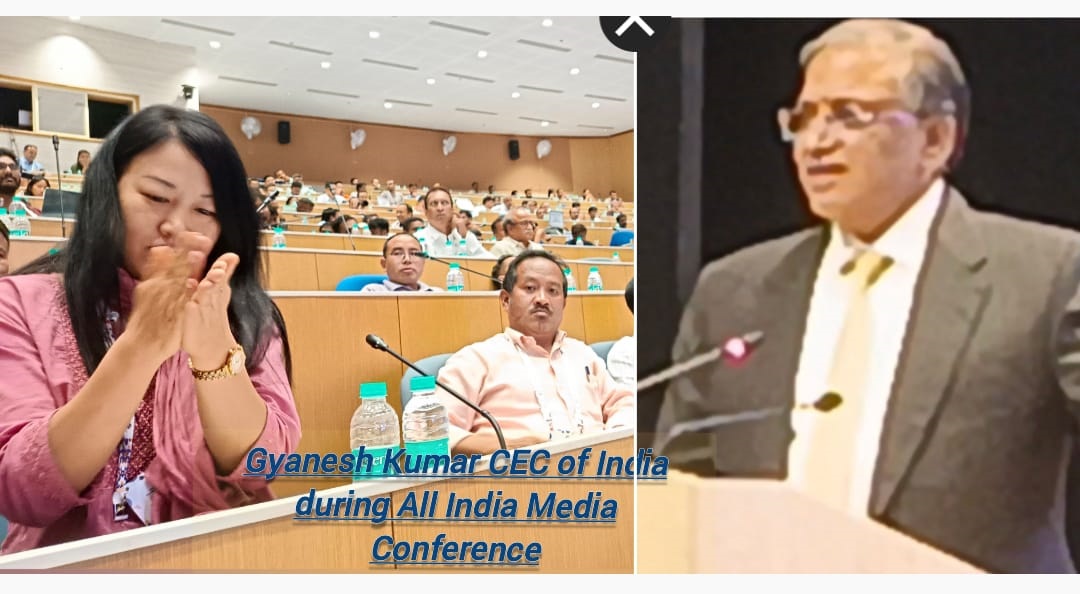
New Delhi, July 17: Chief Election Commissioner (CEC) Gyanesh Kumar on Friday reiterated that every election in India is conducted strictly in accordance with the Constitution, electoral laws and the guidelines of the Election Commission of India (ECI), stressing that there is no room for bias or deviation from established legal provisions.
Addressing journalists at the All India Media Conference organised by the ECI at the India International Institute of Democracy and Election Management (IIIDEM) in New Delhi, Kumar emphasised the Commission’s commitment to neutrality.
“Elections in India are held as per the Constitution, electoral laws and the instructions of the Election Commission. There is no right, no left—everything follows the written law,” he said.
Highlighting the scale of the country’s electoral system, Kumar said the ECI is the largest election management organisation in the world, catering to nearly 95 crore electors. He noted that India’s electorate is larger than the combined electorates of North America, South America, Europe, Africa and Australia.
The CEC explained that the electoral roll is a dynamic document that is continuously updated through the addition, deletion and correction of voter details. Around 27 lakh officials, including Booth Level Officers (BLOs), are involved in the preparation and revision of electoral rolls across the country.
He said the process includes extensive field verification, while Booth Level Agents (BLAs) appointed by recognised political parties also scrutinise the rolls. Draft electoral rolls are published for public review, claims and objections are invited through prescribed forms, and the rolls remain open for continuous updates even after final publication.
Underscoring the Commission’s focus on transparency, Kumar said a vast amount of election-related information is made available on the ECI’s official website, enabling citizens, political parties and the media to independently verify electoral data.
Explaining the polling process, he said every stage of voting is carried out in the presence of polling agents representing candidates. Before polling begins, a mock poll is conducted to test the functioning of the Electronic Voting Machines (EVMs) and Voter Verifiable Paper Audit Trail (VVPAT) system, after which polling agents sign the mock poll certificate.
After polling concludes, agents verify the total number of votes recorded in Form 17C (Part I) before the EVMs are sealed with their signatures. During counting, counting agents once again verify the figures recorded in Form 17C before the votes are counted and the results declared.
Kumar said these multiple layers of verification—from electoral roll preparation to polling and counting—help ensure transparency, accountability and public confidence in India’s democratic process.
He also highlighted the role of the media in strengthening democracy, stating that informed and responsible reporting plays a vital role in enhancing transparency and maintaining public trust in the electoral system.