

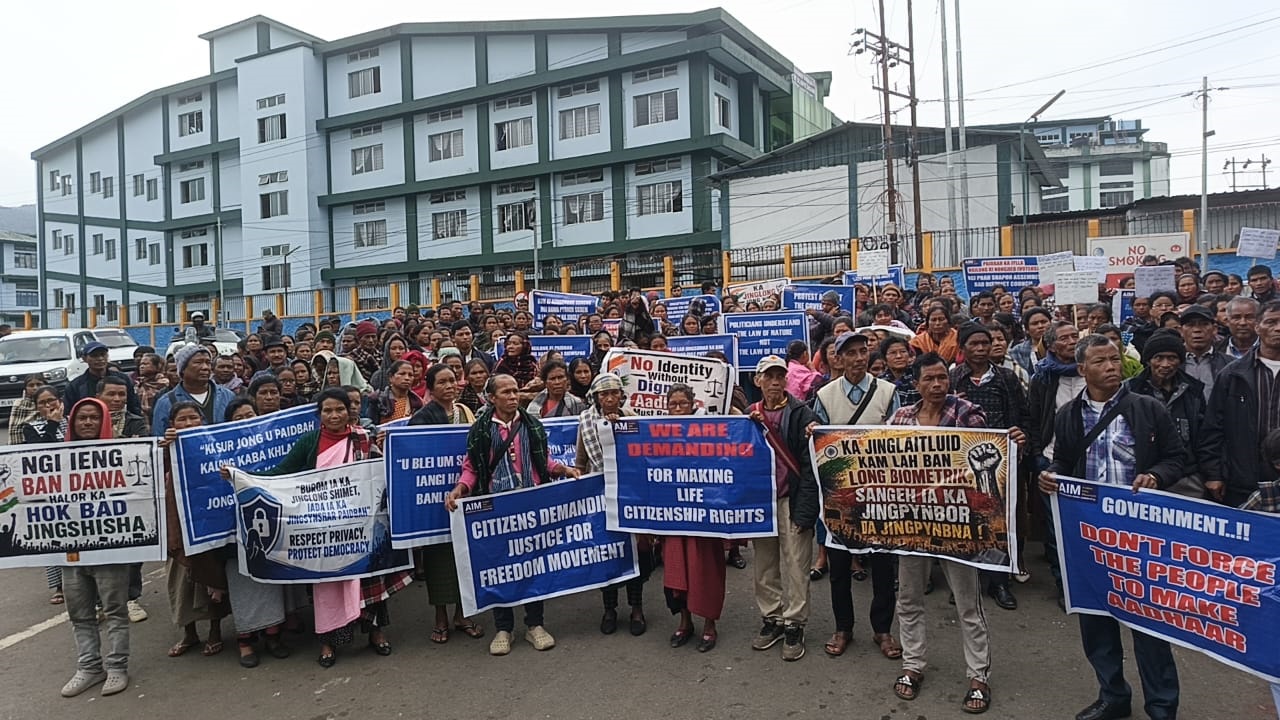
Shillong, April 28: The All India Movements (AIM) Meghalaya, led by its Chairman Bah Banshailang Marbaniang, on Tuesday organised a public meeting near Civil Hospital to raise awareness among citizens against what it termed as the “mandatory imposition” of Aadhaar.
Addressing the gathering, Marbaniang stated that Aadhaar should not be treated as a fundamental requirement in an individual’s life or as definitive proof of identity and existence. He argued that under the Constitution of India, the Electoral Photo Identity Card (EPIC), commonly known as the Voter ID, remains the primary document to establish citizenship.
He further maintained that additional identification documents such as Aadhaar should not be necessary for accessing government benefits, including welfare schemes. Referring to judicial pronouncements, Marbaniang claimed that Aadhaar is not an absolute requirement, but alleged that both central and state governments continue to pressure citizens to enrol, warning of possible denial of benefits.
According to him, such benefits include access to the Meghalaya Health Insurance Scheme (MHIS), ration supplies, job cards, education services, and banking facilities.
Members of AIM also criticised elected representatives and government officials for what they described as a lack of clarity on the issue. The organisation warned that if Aadhaar enrolment continues to be enforced, citizens may resort to boycotting the 2028 elections, arguing that such policies undermine the relevance of the EPIC.
During his address, Marbaniang also highlighted broader socio-economic concerns, including rising poverty and unemployment across various districts of the state. He emphasised that while development initiatives and technological advancements are being introduced, they must deliver tangible benefits to grassroots communities.
He added that increased automation should generate employment opportunities rather than displace workers.
Calling for transparent governance, Marbaniang stressed that policies must align with constitutional provisions and judicial rulings. He also underscored the urgent need to address youth unemployment through enhanced skill development programmes and employment-oriented policies.
In addition, he raised concerns regarding healthcare practices, alleging that there are attempts in certain hospitals to pressure vaccinations among young girls, and urged parents to remain vigilant.
He concluded by calling for collective cooperation between citizens and leadership to ensure sustainable development and the overall welfare of the state.