
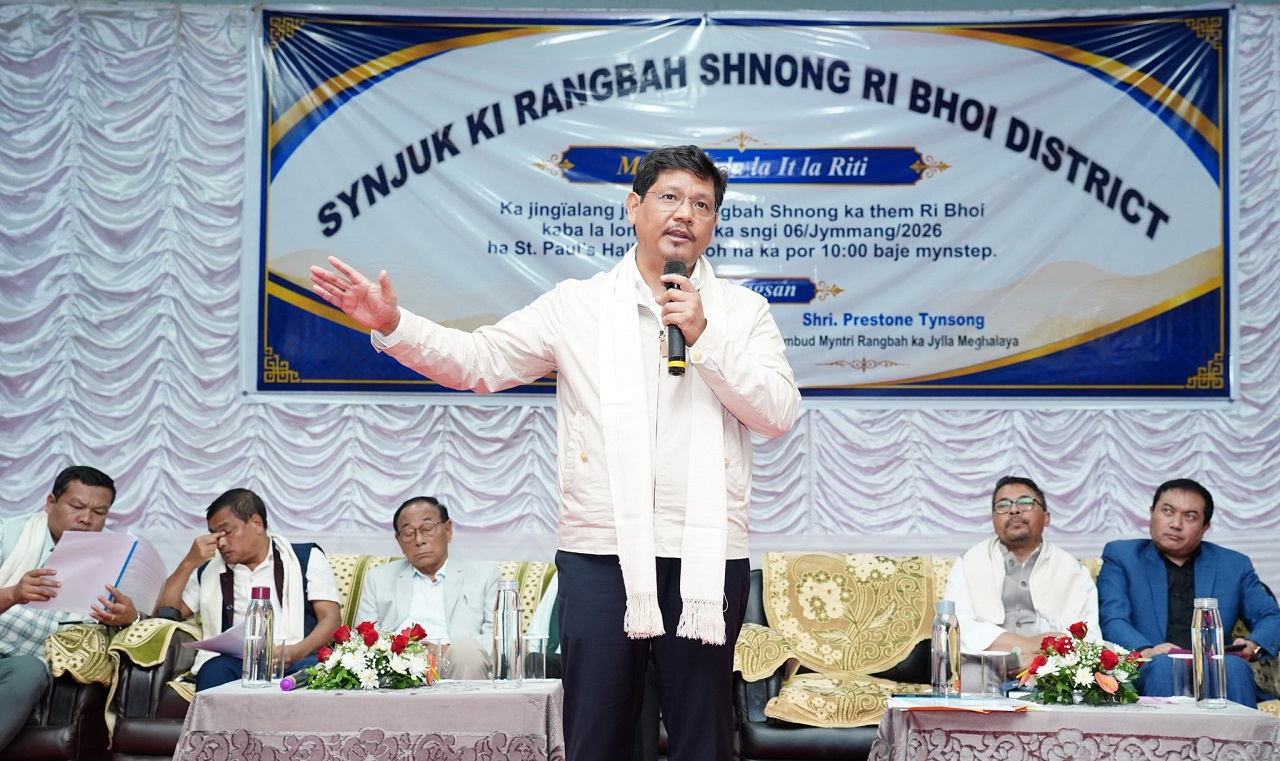
SHILLONG, MAY 5: Chief Minister Conrad K Sangma lauded the role of the Rangbah Shnong in preserving the social fabric of Meghalaya and serving as an important bridge between the government and the people.
Addressing a programme organized by the Synjuk ki Rangbah Shnong Ri Bhoi at St. Paul’s Parish Hall, Nongpoh, Sangma reiterated the government’s commitment to inclusive and balanced development across all districts of the state.
He reflected on Meghalaya’s development journey since 2018, stating that governance must be shaped according to the State’s unique context. “Since 2018, with the blessings of the Almighty and the support of the people of our State, we embarked on a journey with the hope of transforming Meghalaya. Our intention has always been to make a meaningful difference in the lives of our people and to take the State forward. We realised early on that every State is different, and what works elsewhere cannot simply be replicated in Meghalaya. We therefore had to design our own approach suited to our unique context and strengths,” he said.
Explaining the government’s development approach, he highlighted key focus areas. “We have focused on infrastructure development, people-centric programmes, and strengthening traditional institutions. Infrastructure such as roads, offices, and tourism facilities form the backbone of growth. At the same time, programmes like CM-ELEVATE, CM-ASSURE, CM FARM+, and Self Help Group initiatives ensure that development directly reaches the people.”
He added that traditional institutions remain central to governance. “Our community and traditional institutions are our greatest strength. No development model in Meghalaya can succeed without their involvement, and therefore Dorbar Shnongs, village authorities, and traditional heads remain key partners in governance.”
Appreciating the initiative of the Synjuk, he said, “I am truly happy that the Synjuk ki Rangbah Shnong Ri Bhoi has taken this initiative. We may hold different positions, but our goal remains the same — to serve the people and improve their lives.”
During the programme, Synjuk ki Rangbah Shnong Ri Bhoi submitted a memorandum to the Chief Minister highlighting key developmental priorities and institutional requirements of Ri Bhoi district. The memorandum, categorised under infrastructure development and institutional and administrative strengthening, sought the establishment of a Government College at Nongpoh, strengthening of power infrastructure and manpower, regulated livestock markets, improved border area development, healthcare services, and administrative support in remote areas.
At the outset, the President of the Synjuk highlighted the need to ensure that development activities in Ri Bhoi are carried out without unnecessary external interference and stressed the importance of safeguarding local interests in the district’s development process.
Responding to issues raised in the memorandum, the Chief Minister stated that the demand for a Government College in Nongpoh would be examined, noting the government’s continued support for people’s colleges while assessing long-term feasibility.
On power supply, he acknowledged disruptions and stated that the issue largely lies in the distribution network. He informed that a 132 KV substation at Nongpoh is nearing completion and will significantly improve power supply, while additional substations and temporary manpower strengthening are being planned in a phased manner.
On livestock and market-related concerns, he noted that schemes like the Piggery Mission and CM-ELEVATE have increased local production, but demand still requires supply from outside the State. He said the proposal for a regulated livestock market, including pork, would be examined, and stressed the need for monitoring pricing and market practices through administrative and police coordination.
On border area issues, including Mawlasnai and surrounding villages, he assured continued coordination with the Government of Assam to ensure non-interference in developmental activities. He also confirmed that GPS and mapping discrepancies where villages are shown under Assam would be taken up for correction with the concerned authorities.
He further stated that village-wise electrification coverage under central schemes would be reviewed, and healthcare manpower issues in PHCs, including Mawlasnai, would be taken up with the Health Department. On concerns of insecurity in border areas, he said the district administration would strengthen presence through designated officers for better monitoring and response.
He also encouraged citizens to use the CM Connect helpline (1971) for grievance redressal, assuring timely action on complaints received.
The Chief Minister also announced support for institutional strengthening of the Synjuk, stating that ₹50 lakh has been sanctioned for construction of its office, to be implemented through convergence between the Chief Minister’s Special Development Fund and the Meghalaya Basin Development Authority.
He concluded by assuring that all issues raised by the Synjuk would be examined by the concerned departments.
Meanwhile, Deputy Chief Minister Prestone Tynsong, who attended as Guest of Honour, appreciated the resolution adopted by the Synjuk and said it was the first time he had seen such a collective resolution by traditional heads.
He expressed hope that it would inspire similar initiatives in other districts, stating, “This is the first time I have seen such a resolution being adopted by the Synjuk, and we are happy to witness this. I hope this sets an example for other districts as well.”
He reaffirmed the government’s commitment, saying, “Under the leadership of our Chief Minister, we will continue to work hand in hand to achieve the aspirations of the people of Ri Bhoi.”
He further stated that the government remains committed to achieving lasting solutions.
Earlier, Chairman of Synjuk ki Rangbah Shnong Ri Bhoi, B.B. Makdoh, in his welcome address, said the programme was organised to bring all Rangbah Shnong of Ri Bhoi under one platform for collective development efforts.
He reiterated that the Synjuk remains committed to working in close partnership with the government for the development of the district.
Others present included Cabinet Minister Sosthenes Sohtun, Nongpoh MLA Mayralborn Syiem, Umsning MLA Dr. Celestine Lyngdoh, Mawhati MLA Charles Marngar, members and representatives of Synjuk ki Rangbah Shnong Ri Bhoi, and senior district officials.
The programme concluded with a vote of thanks proposed by P.B. Sylliang, Secretary of Synjuk ki Rangbah Shnong Ri Bhoi, followed by the flagging off of 37 Waste Collection E-Vehicles in the presence of dignitaries.