
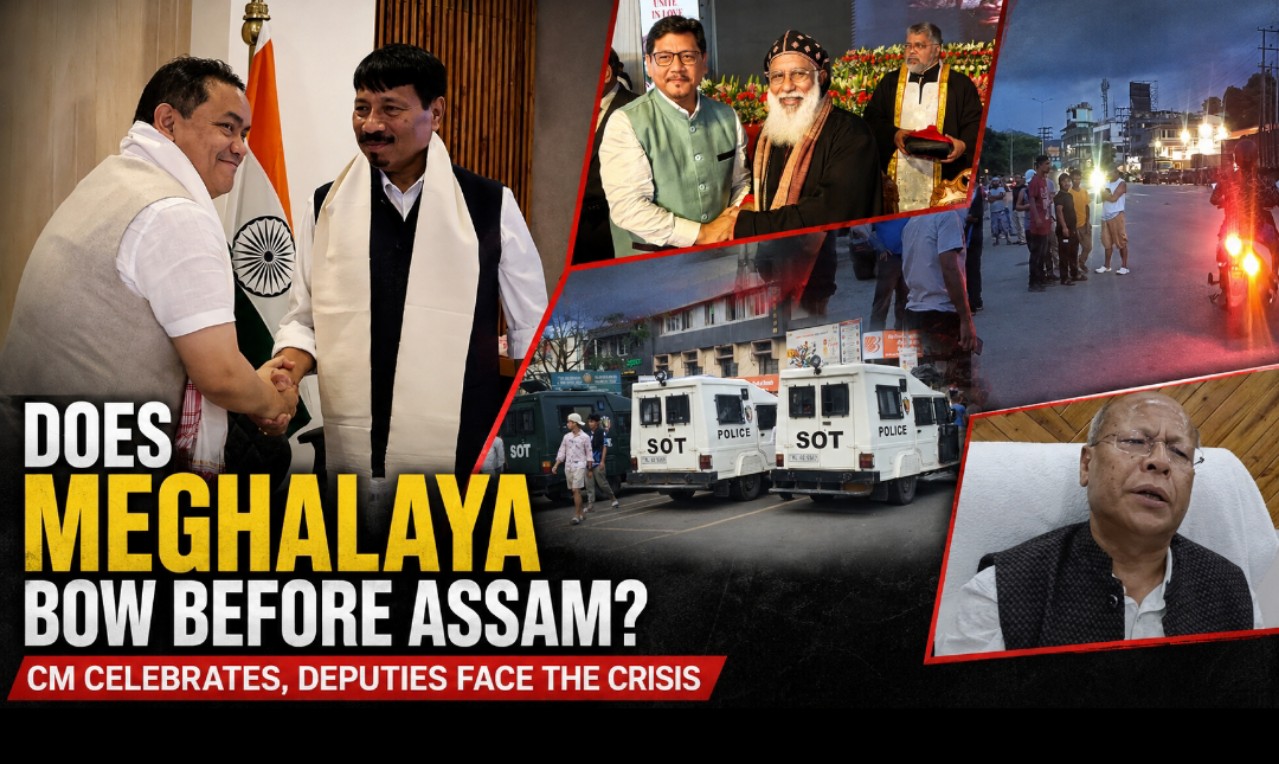
The Chief Minister Applauds in Good Times, While His Deputies Face the Crises
SHILLONG, AUGUST 22: The developments following the motorcycle rally organised by the Khasi Students’ Union (KSU) have raised serious questions about the Meghalaya Government’s ability and willingness to protect the rights, dignity and security of its own citizens.
The subsequent disruption of movement between Meghalaya and Assam, including reports of Meghalaya-registered vehicles being stopped at Khanapara, exposed how vulnerable the state remains when its vital connectivity with Assam is affected. Private vehicles, tourist taxis and other commuters were reportedly caught in the disruption.
It was against this backdrop that the Meghalaya Government initiated discussions with its Assam counterpart.
That raises an uncomfortable question: Why does the Meghalaya Government appear to respond with urgency when pressure comes from outside the state, while concerns raised by its own people often take much longer to receive a meaningful response?
There can be absolutely no justification for assaulting commuters, vandalising vehicles or engaging in any other unlawful activity. Those responsible must be identified through a fair investigation and prosecuted according to law.
But accountability must be even-handed.
The unlawful actions of some individuals during the KSU rally cannot, by themselves, erase the grievances that led to the agitation. Nor should criticism of the Government be treated as an excuse for criminality.
At the same time, the manner in which the police handled the unrest has generated questions among sections of the public. Allegations concerning the use of tear gas in residential areas and the arrests of KSU leaders require transparent scrutiny. Law and order must be maintained, but the exercise of state power must also remain proportionate, lawful and accountable.
Meghalaya’s Dependence on Assam
The episode has also exposed a much deeper structural problem.
Meghalaya continues to depend heavily on Assam for the movement of food, fuel and other essential commodities. When transportation routes are disrupted even temporarily, the consequences can quickly be felt across the state.
More than five decades after attaining statehood, Meghalaya should be asking itself a fundamental question:
Why does a state blessed with abundant land, water, forests and agricultural potential remain so dependent on its neighbour for basic necessities?
This is not merely a question of Assam-Meghalaya relations. It is a question of economic planning, food security and self-reliance.
Investment Cannot Come at the Cost of Public Trust
The controversy surrounding the proposed Shree Cement-related activities in East Jaiñtia Hills raises another important issue.
Investment and industrial development are necessary for Meghalaya. But development cannot simply mean facilitating projects while communities are left questioning whether their voices are being heard.
Residents, landowners and civil society organisations have raised concerns regarding consultation, environmental safeguards and the impact of the proposed activities.
The Government must therefore demonstrate—not merely assert—that development projects are being pursued transparently and with adequate regard for the rights and concerns of affected communities.
A government that expects citizens to trust its development agenda must first earn that trust.
Where Are the Elected Representatives?
The silence of several MLAs from the Khasi and Jaiñtia Hills is equally troubling.
During elections, representatives seek the people’s mandate by promising to speak for their constituencies. But when serious controversies arise, people expect more than social-media statements.
They expect their representatives to stand up in the Assembly, question ministers, demand answers and force the Government to confront uncomfortable issues.
Democracy does not end after election day.
The Chief Minister Cannot Remain Above the Crisis
Chief Minister Conrad K. Sangma must also speak clearly on the issues confronting the state.
The Chief Minister cannot be visible only when Meghalaya is celebrating—at festivals, sporting events, inaugurations and other public programmes. Leadership is tested most severely when the streets are tense, communities are anxious and the Government is under pressure.
The people need to see their Chief Minister during difficult moments as well.
The impression that crises affecting the Khasi and Jaiñtia Hills are being left primarily to ministers and regional leaders to manage is not healthy for the state.
The Chief Minister is the head of the Government. Ultimately, responsibility rests with him.
Friendship with Assam Must Not Mean Submission
Meghalaya must maintain cordial and constructive relations with Assam. The two states share deep economic, social and geographical links, and neither benefits from unnecessary confrontation.
But friendship cannot mean surrender.
Cooperation between Meghalaya and Assam must be based on mutual respect, equality and protection of citizens on both sides of the border.
If Meghalaya’s vehicles are stopped, its commuters face harassment, or essential supplies are threatened, the state Government must respond firmly and diplomatically—not from a position of fear, but from one of confidence and constitutional responsibility.
Likewise, Meghalaya must ensure that its own citizens and visitors are protected from violence and intimidation.
The Real Test of Leadership
The events of the past few days should therefore become more than another political controversy.
They should force Meghalaya to ask some difficult questions:
Can the state protect its citizens?
Can it maintain law and order without undermining public confidence?
Can it develop greater economic self-reliance?
Can it balance investment with community rights and environmental protection?
And can its political leadership stand together when the state faces a crisis?
During good times, leaders applaud, inaugurate, celebrate and pose for photographs.
But leadership is not measured by how loudly a government celebrates success.
It is measured by what it does when its people are angry, afraid, divided or under pressure.
That is when Meghalaya needs its leaders to step forward—not disappear, remain silent, or leave their deputies to face the storm.
Cordiality with Assam is necessary. Submission is not.
Development is necessary. Blind facilitation is not.
Law and order is necessary. Selective accountability is not.
And leadership is necessary—not only in good times, but especially in bad ones.