
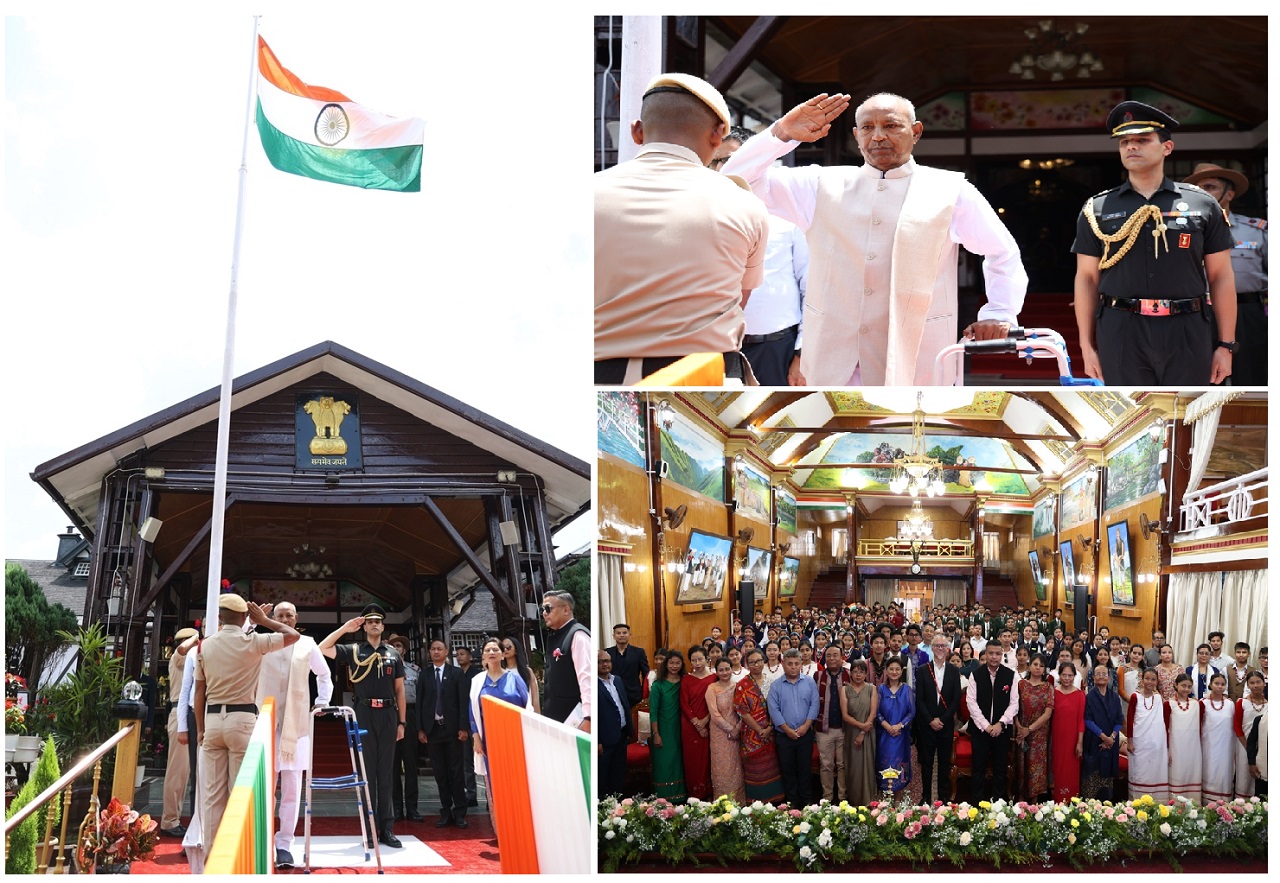
Shillong, August 14, 2026: Lok Bhavan Shillong, in collaboration with the Arts and Culture Department of the Government of Meghalaya, observed Partition Horrors Remembrance Day on Friday to commemorate the victims and survivors of the Partition of India in 1947.
The programme began with the hoisting of the National Flag by Governor C.H. Vijayashankar in the presence of the Director of the Arts and Culture Department, government officials, students and invited guests.
The gathering later moved to the Durbar Hall of Lok Bhavan, where students presented cultural programmes, followed by an address on the human cost and enduring impact of Partition.
Speaking on the occasion, Dr. David Arnold Kharchandy, Assistant Professor at Synod College, said Partition should not be viewed merely as a political event marking the end of British rule and the creation of India and Pakistan.
He said that for millions of ordinary people, Partition meant the loss of homes, separation of families, disruption of communities and uncertain journeys after people were forced to leave behind their homes and belongings.
Dr. Kharchandy said maps and political boundaries cannot adequately capture the human suffering caused by Partition, including the experiences of mothers travelling with children, elderly people leaving homes where they had lived for decades and families travelling in overcrowded trains without knowing whether they would reach their destinations safely.
He stressed that remembering Partition is important because history must go beyond statistics and political boundaries and acknowledge the experiences of those who lived through the tragedy.
Dr. Kharchandy also cautioned against viewing Partition through a communal lens or reducing its suffering to a conflict between communities. He noted that people from different religious and social backgrounds suffered and warned that portraying the tragedy as “our people versus their people” would prevent future generations from understanding its broader lessons.
Highlighting the impact on Meghalaya and the Northeast, he said Partition had significant consequences for the region, particularly after the creation of the border with what is now Bangladesh. Migration increased, traditional trade routes were altered and families and communities were separated by newly created political boundaries.
“Partition is not merely the story of Delhi, Punjab or Bengal. It is also part and parcel of the history of the Northeast,”
he said, urging students to explore the region’s experiences of Partition in greater depth.
He called upon students to remember the victims and survivors, study history from multiple perspectives, question rumours and stereotypes, verify information and reject communal propaganda. He also urged them to respect people across religious, social, caste, class and linguistic backgrounds.
The observance concluded with a reminder of the immense human cost of Partition and the responsibility of younger generations to remember its victims, learn from history and contribute towards building a peaceful and inclusive society.